Your One Stop Bio Solutions
Bridge the gap between academic theory and real-world computational biology research with guidance from industry scientists.
Work directly with real RNA-Seq raw fastq files from NCBI SRA and 3D protein-ligand complexes from PDB, running alignments, docking, and MD simulations.
Learn under experienced bioinformaticians and structural biology researchers with dedicated doubt-clearing sessions every Friday.
Produce publication-ready figures, volcano plots, PCA clusters, 2D/3D interaction diagrams, and RMSD/RMSF curves for your Master's thesis or PhD applications.
Master Linux command line, R, AutoDock Vina, PyMOL, Discovery Studio, and GROMACS highly valued in modern biotech, pharma, and CRO roles.
Choose between our 45-Day Focused Single Track (RNA Sequencing OR Drug Discovery & Molecular Docking) or the complete 45-Day Comprehensive Dual Track (30 Live Sessions) for high-impact research.
Monday & Wednesday | Linux, Conda, HISAT2/STAR, featureCounts, R & DESeq2 Workflows.
We understand that your university requires formal paperwork, guide approvals, and proof of research. Biosyntiya provides end-to-end documentation so you receive 100% academic credit without stress.
Issued within 24 hours of enrollment with an authenticated registration number, seal, and faculty endorsement addressed directly to your Dean or HOD.
A formal 30-session structured delivery calendar matching university summer/winter break guidelines, ensuring instant credit clearance.
Detailed work diaries and attendance logs reflecting your practical computing hours, ready for internal college mentor sign-offs.
Includes a standardized 15-20 page project report format plus official Letters of Recommendation (LOR) for scholars pursuing higher studies.
No toy demos or simulated interfaces. You will install, script, and execute pipelines using the exact production software suites deployed across premier biopharma R&D laboratories, CROs, and university supercomputing centers.
High-throughput virtual screening engine for flexible protein-ligand docking, grid parameterization, and binding free energy scoring.

Industry-standard GPU-accelerated molecular dynamics engine. Solvation, NVT/NPT ensembles, and full production simulations of complexes.

Google DeepMind's breakthrough AI structure repository. High-accuracy 3D tertiary model retrieval, pLDDT confidence scores & PAE matrix analysis.
Gold-standard scientific visualization suite for inspecting binding pockets, catalytic residues, hydrogen bonds, and rendering ray-traced publication figures.
Statistically rigorous negative binomial modeling for differential expression, dispersion estimation, independent filtering, and sample PCA.
High-performance splice-aware read mapping against the GRCh38 human genome index. Handles spliced exon-exon junctions and generates sorted BAM files.
Comprehensive 2D & 3D non-covalent interaction maps: hydrophobic bonds, π-π stacking, electrostatic clashes, and ligand pharmacophore analysis.

Calculates physicochemical properties, pharmacokinetics, drug-likeness radars (Lipinski, Veber, Ghose), and blood-brain barrier permeability.

The global primary archive for experimental 3D coordinates. Structure selection based on resolution (Å), R-free values, co-crystallized ligands, and chains.

Authoritative resource for protein sequences, functional annotations, active site catalytic residues, post-translational modifications, and disease mutations.
Open-source platform for network pharmacology. Topologically calculates degree, betweenness centrality, and isolates densely connected hub protein clusters.
Constructs physical and functional protein-protein interaction networks from experimental evidence, automated co-expression, and curated databases.
Comparative structural modeling by satisfaction of spatial restraints. Generates refined 3D coordinates when target experimental structures are absent.
Post-MD trajectory visualization, hydrogen-bond persistence tracking, Root Mean Square Deviation (RMSD), RMSF fluctuations, and Radius of Gyration (Rg).
Universal functional enrichment package in R. Executes Gene Ontology (GO) and KEGG GSEA, generating publication-ready dot plots, cnetplots, and ridgelines.

Curation of small-molecule ligand libraries. Download canonical SMILES, 3D SDF structures, bioactivity IC50 values, and molecular fingerprint descriptors.
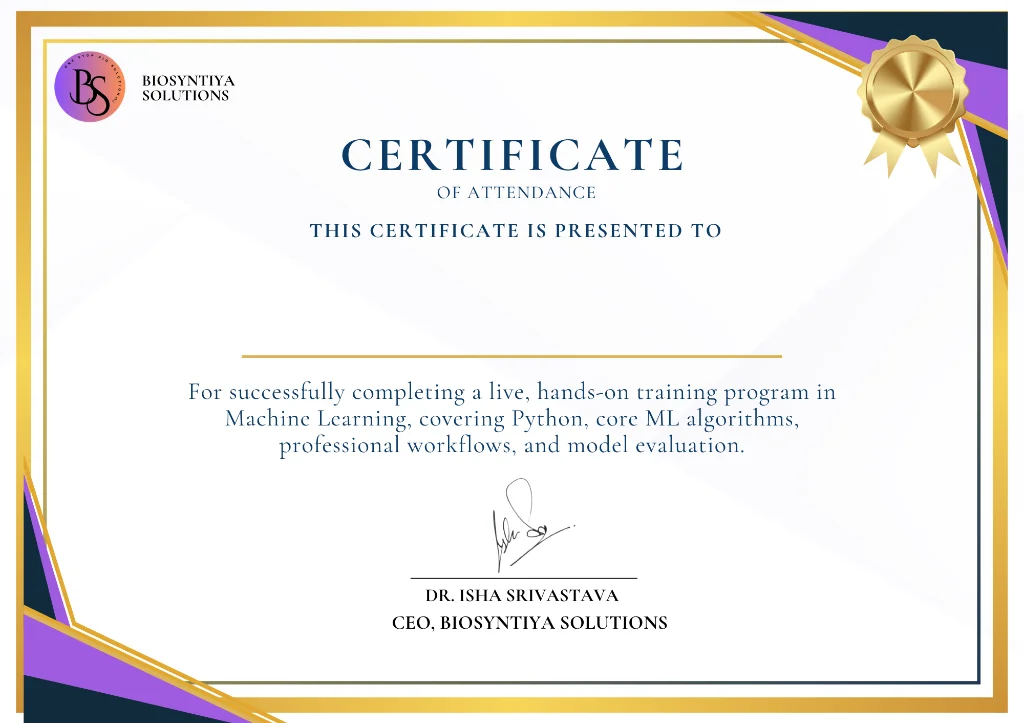
Strengthen your academic CV, thesis submissions, and global Master’s/PhD applications with an authenticated research credential that documents your live hands-on computational biology competencies.
Instant digital scan verification allows university faculty and interview panels to validate your research completion.
Signed by Dr. Isha Srivastava (CEO, Biosyntiya Solutions) with official Biosyntiya organizational seal.
Explicitly documents hands-on pipelines mastered across RNA-Seq (HISAT2/STAR/DESeq2) and Drug Discovery (AutoDock Vina/GROMACS/PyMOL).
Easily showcase your credential in the Licenses & Certifications section of your professional profile.
Read how previous research interns applied Biosyntiya's computational pipelines to their master's dissertations, college credits, and doctoral publications.
“The mentorship was invaluable — one can have answers to their basic questions without any judgment, and most importantly it is beginner friendly. Having dedicated doubt clearing sessions alongside live classes helped me directly apply the concepts to my own university research project.”

“This internship has been a transformative learning experience, providing rigorous exposure to genome data analysis on real datasets. It gave me a thorough understanding of NGS workflows, quality control, and downstream biological insights that elevated my thesis work.”
“The internship introduced me to practical workflows structured in a way that makes complex computational steps feel clear and manageable. It is the best practical foundation I have had for building reproducible computational biology pipelines.”

Choose the duration that fits your research schedule. All tracks include live interactive classes, assignments, doubt clearing, and e-verified certificates.
UG, PG, PhD, and Post-Doctoral Scholars in Life Sciences & Biotech.
Industry Scientists, Faculty, Clinical Researchers & Data Analysts.